


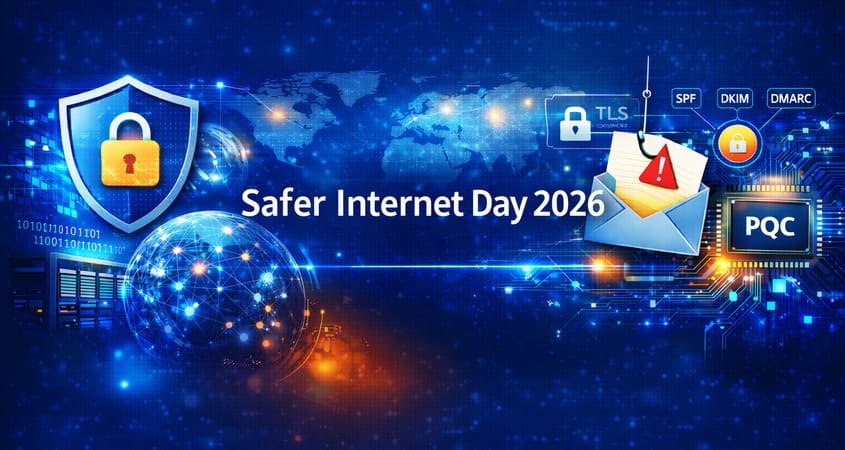
On 10 February 2026 we observe Safer Internet Day (Safer Internet Day), an initiative that for years has reminded us that online security is not a one time action, but a process encompassing technology, procedures, and human decisions. In 2026 this message gains particular significance. Today the Internet is critical infrastructure for business, public administration, and trust services, while the scale of threats is growing faster than ever before.
This article, prepared from the perspective of security architecture and cryptography, shows how to build a secure Internet in practice, from the TLS and PKI layers, through email and domain identity, to automation and long term resilience.
Secure Internet 2026: a context that cannot be ignored.
In recent years, security has ceased to be an “IT add on”. It has become a regulatory requirement, an element of brand reputation, and a decisive factor for business continuity. The threat landscape in 2026 includes, among others:
- mass phishing and vishing campaigns leveraging AI,
- the harvest now, decrypt later attack model,
- shortening lifecycles of TLS certificates,
- growing regulatory requirements (NIS2, DORA, PCI DSS 4.0),
- increasing dependence on email and API based communication.
A secure Internet today does not mean the absence of incidents. It means the ability to limit them, detect them, and prove that systems operate in accordance with an adopted trust policy.
TLS and PKI: a foundation that must operate flawlessly.
TLS transport encryption remains the basis of data confidentiality and integrity. However, in 2026 the key question is not “do we have HTTPS?”, but rather:
- whether certificates are valid and correctly issued,
- whether cryptographic keys meet current requirements,
- whether certificate lifecycle management is automated,
- whether the organization is prepared for further reductions in certificate validity periods.
From a PKI perspective, Internet security is continuity of trust, from certificate issuance, through its use in services, to timely renewal and key rotation. Lack of automation in this area is no longer a purely technical risk. It is an operational and business risk.
Email: the weakest link or a key line of defense?
Despite widespread use of TLS, SPF, DKIM, and DMARC, email remains the primary vector of successful attacks. The reason is simple: the final decision still belongs to a human. In 2026, email security is based on three pillars:
- Technical domain identity, correct configuration of SPF, DKIM, and DMARC.
- Visual trust layer, VMC and BIMI certificates that allow users to recognize an authentic sender.
- Monitoring and policy enforcement, DMARC reports, anomaly analysis, and response to abuse.
A secure Internet is not only about message encryption. It is about minimizing the space for cognitive manipulation of the user.
Automation as a prerequisite for security.
One of the paradoxes of security in 2026 is that the more complex systems become, the less room there is for manual actions. This applies in particular to:
- renewal of TLS and email certificates,
- monitoring expiration and misconfigurations,
- responding to incidents related to domain identity,
- maintaining compliance with audit requirements.
Automation is not a luxury. It is the only scalable method of maintaining security in production environments.
Long term security and the cryptography of tomorrow.
Safer Internet Day is also a good moment to look beyond the current year. Data encrypted today often must remain confidential for 10, 15, or even 20 years. Therefore, increasing importance is placed on:
- strategies for resilience against future cryptographic breakthroughs,
- architectures that enable algorithm agility and rotation,
- planning migration toward post quantum cryptography (PQC).
A secure Internet is not only about the present moment. It is about designing with the next decade in mind.
The role of organizations and ecosystem responsibility
Building a secure Internet is not the task of individual companies. It is the effort of an entire ecosystem, including technology providers, operators, supervisory institutions, and incident response teams. In Europe, key roles are played by, among others:
- ENISA, shaping standards and recommendations,
- CERT Polska, responding to incidents and educating the market.
However, even the best guidelines will not replace conscious architectural decisions made by organizations themselves.
What does Safer Internet Day mean for business?
For companies and institutions, 10 February should not be merely a symbolic date. It is a good moment to:
- review certificates and TLS configurations,
- verify email policies and DMARC reports,
- assess the level of automation in security processes,
- update the cryptographic roadmap for the coming years.
A secure Internet begins with concrete actions, not declarations. Safer Internet Day 2026 reminds us of one fundamental truth: trust on the Internet is not granted once and forever. It is created at the intersection of cryptography, automation, and responsible human decisions. TLS, PKI, email, and domain identity are not separate technologies. They form a coherent digital trust architecture on which the stability of the modern Internet depends.
At HEXSSL, we have viewed security in this way for years, systemically, long term, and without marketing simplifications. Safer Internet Day is a good opportunity to apply this perspective not only in theory, but also in practice.