


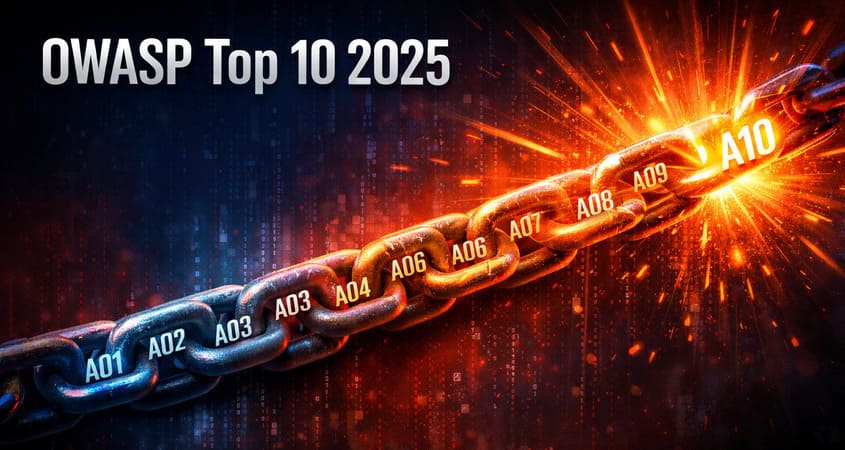
By the end of 2025, OWASP published the final version of OWASP Top 10 2025. Although the name suggests another iteration of a well known document, in practice this edition is one of the most mature and, at the same time, one of the most uncomfortable releases in the project’s history. Uncomfortable because OWASP Top 10 2025 explicitly shows that a significant portion of web application security issues does not stem from isolated coding mistakes, but from design decisions, architectural simplifications, and the lack of consistent security processes across the entire application lifecycle.
This is also an edition that clearly distinguishes between:
- the release candidate (RC), intended for consultation (discussed in our earlier article: OWASP Top 10 2025 – What’s New and How It Impacts Application Security?),
- and the final version, which serves as a reference document.
In the context of audits, penetration testing, and regulatory compliance, only the final version of OWASP Top 10 2025 published at the end of 2025 is relevant.
OWASP Top 10 – a document that is often misunderstood.
Before moving on to the individual risk categories, it is worth pausing for a moment to clarify what OWASP Top 10 actually is and what it was never meant to be.
OWASP Top 10:
- is not a standard,
- is not a certification,
- is not a compliance checklist,
- is not a replacement for penetration testing.
It is a risk classification model whose primary goal is to organize the most common and most costly classes of web application security issues. A mistake still made by many organizations is treating OWASP Top 10 as a list of “10 things to fix”. In reality, this document should be read as a map, not as an assembly manual. A map highlights areas of risk, but it does not replace knowledge of the terrain.
The 2025 context: a changing web application landscape.
OWASP Top 10 2025 clearly reflects how web applications have evolved in recent years. Modern systems are no longer single applications running on a single server, but complex ecosystems composed of:
- frontend and backend applications,
- public and internal APIs,
- cloud environments,
- automated CI/CD pipelines,
- external libraries and open source components.
In such an environment, security is no longer a one dimensional problem. A single vulnerability rarely exists in isolation. Much more often, it is part of a chain of events in which a design flaw enables abuse and the lack of monitoring allows the incident to remain undetected. OWASP Top 10 2025 was designed precisely with this layered landscape in mind.
The structure of OWASP Top 10 2025 as a layered model.
One of the most effective ways to interpret OWASP Top 10 2025 is to view it as a layered risk model. Individual categories do not compete with one another, but frequently complement each other.
 At the highest level, four areas can be distinguished:
- Design and architecture.
- Implementation and components.
- Configuration and operations.
- Processes, monitoring, and response.
This perspective is critical because it shows that not all problems can be addressed with the same tools.
A01: Broken Access Control – when business logic becomes an attack vector.
Broken Access Control has held the top position in OWASP Top 10 for years, and the 2025 edition only confirms that this is not a problem the industry has learned to solve effectively. Importantly, OWASP increasingly emphasizes that the root cause of these vulnerabilities is rarely a single implementation bug. Much more often, they result from inconsistent or poorly designed authorization logic created without a complete threat model.
In practice, Broken Access Control appears when an application begins to “trust” that users will follow the intended usage scenarios. When access rules are fragmented, context dependent, or implemented inconsistently, attackers can bypass protections not by technically breaking mechanisms, but by manipulating business workflows.
Most often, these issues result from:
- a lack of a consistent authorization model,
- excessive trust in client side data,
- ambiguous business rules,
- API design without clearly defined roles.
OWASP Top 10 2025 shows that this problem intensifies as the number of APIs, microservices, and integrations grows. Each additional interaction point increases the risk that access control will be implemented inconsistently. As a result, the application may formally “check permissions” while, in practice, granting access to resources that were never intended to be available to a given user.
A02: Cryptographic Failures – when cryptography exists only on paper.
The Cryptographic Failures category in OWASP Top 10 2025 is one of the strongest warning signals for organizations that equate security with the mere use of encryption. OWASP makes it clear that incorrectly implemented cryptography not only fails to protect, but often creates a false sense of security.
In practice, these issues stem from treating cryptography as an infrastructural add on rather than an integral part of application architecture. Encryption mechanisms are frequently deployed without a consistent key management policy, without key rotation controls, and without a clear distinction between data that requires protection and data of lower sensitivity.
A02 includes, among other things:
- incorrect TLS configurations,
- outdated algorithms,
- improper key management,
- the absence of consistent encryption for data at rest.
This is a particularly deceptive area because an application may appear “secure” while, in reality, critical data remains exposed. OWASP Top 10 2025 also shows that cryptography often fails at the boundaries between systems. Data may be properly protected in one component and then transmitted or stored unencrypted in another. Such inconsistencies are difficult to detect and even harder to remediate without a holistic view of the architecture.
A03: Injection – a vulnerability that has adapted to modern systems.
Injection is one of the oldest categories in OWASP Top 10, yet the 2025 edition clearly demonstrates that the problem has not disappeared, but has changed its form. Modern injection attacks rarely involve simple code injection into a single parameter. Much more often, they are part of complex interactions between system components.
Instead, we increasingly see:
- complex attack chains,
- abuse of APIs,
- issues arising from multi system integrations.
Modern applications operate across many abstraction layers: ORMs, APIs, message brokers, and queueing systems. Each of these layers interprets data differently. Injection therefore becomes a systemic vulnerability, resulting from incorrect assumptions about where “data” ends and “logic” begins. This is another example of how contemporary vulnerabilities are often the result of interactions between multiple components, rather than a single line of code. OWASP Top 10 2025 emphasizes that effective protection against injection is not limited to input validation. It requires a consistent approach to how data is processed, passed, and interpreted throughout the entire system.
A04: Insecure Design – security that was never designed.
Insecure Design is the category that best reflects the philosophy of OWASP Top 10 2025. It refers to situations where applications are designed without realistically considering threats. These are not coding errors, but rather a lack of defensive mechanisms at the conceptual level of the system.
Insecure Design applies to cases where:
- no threat analysis was performed,
- trust boundaries were not defined,
- abuse scenarios were not considered,
- security was “postponed until later”.
OWASP clearly points out that many applications meet functional requirements but were never designed with abuse in mind. The absence of abuse case analysis, insufficient separation of responsibilities, or excessive simplification of business logic leads to systems that are functionally correct but structurally vulnerable. The most serious problem with Insecure Design is that such flaws cannot be easily “patched”. They require architectural changes that are often costly and difficult to implement in mature systems. OWASP Top 10 2025 clearly signals that security must be designed in, not added at the end. These issues cannot be resolved by a WAF, a vulnerability scanner, or a library update. They require architectural changes and sometimes a redesign of critical system components.
A05: Security Misconfiguration – when reality diverges from assumptions.
Security Misconfiguration remains one of the most practical categories in OWASP Top 10 because it applies to the real environment in which an application operates. Even the best designed system can be effectively compromised if its configuration diverges from security assumptions. OWASP Top 10 2025 shows that problems often stem from default settings, inconsistent hardening, and changes introduced during system operation. In cloud and container environments, this issue is further amplified by the scale and complexity of configuration.
Configuration errors involving:
- servers,
- cloud platforms,
- containers,
- authentication mechanisms
are particularly dangerous because they often do not require advanced attack techniques. It is enough for an application or infrastructure component to be unintentionally exposed. OWASP Top 10 2025 treats this category as evidence that security does not end at the development stage.
A06: Vulnerable and Outdated Components – unseen risk.
Modern applications are largely composed of external components, which means that a significant portion of security risk is inherited rather than directly created by the development team. OWASP Top 10 2025 strongly emphasizes this fact, identifying the lack of control over dependency lifecycles as a key threat. Without proper lifecycle management, an application may:
- use unsupported libraries,
- contain known vulnerabilities,
- inherit risk from external sources.
This problem is not limited to the use of vulnerable libraries, but also includes a lack of awareness of which components are actually present in the application. Without full dependency visibility, an organization loses the ability to assess risk and respond to newly disclosed vulnerabilities. OWASP Top 10 2025 demonstrates that component management is no longer a matter of technical hygiene, but a strategic element of application security.
A07: Identification and Authentication Failures – when identity becomes the weakest link.
Failures in identification and authentication remain one of the most direct paths to application compromise. OWASP Top 10 2025 shows that despite the widespread availability of modern authentication mechanisms, errors in this area are still common. These issues often stem from the absence of a coherent identity management strategy. Login, session, and token mechanisms are frequently designed in isolation, without considering automated attack scenarios, abuse, or privilege escalation.
OWASP Top 10 2025 emphasizes that authentication is not a one time step, but a continuous trust control mechanism. Failures in this area quickly translate into real losses, because they allow attackers to operate fully within a legitimate user context.
A08: Software and Data Integrity Failures – when trust in the process breaks down.
Category A08 in OWASP Top 10 2025 is one of the strongest signals that web application security is no longer limited to code running in production. Increasingly, the source of incidents is not the application itself, but the process that builds, updates, and distributes it. Software and Data Integrity Failures cover situations where organizations lose control over the integrity of code, deployment artifacts, or configuration data. In practice, this means exposure to attacks targeting CI/CD pipelines, code repositories, update mechanisms, and software signing processes. In such scenarios, attackers do not need to break application defenses. It is enough to compromise a trusted element of the process.
OWASP Top 10 2025 clearly shows that trust in automation without verification is one of the most dangerous assumptions in modern DevOps. The lack of integrity controls, insufficient source verification, and excessive privileges in pipelines lead to situations where malicious code reaches production in a way that appears fully legitimate from the system’s perspective. This category is also directly related to data security. Unprotected import, synchronization, or replication mechanisms can allow data manipulation without generating traditional security alerts. As a result, organizations lose not only confidentiality, but also data integrity, which in critical systems can be equally damaging.
OWASP Top 10 2025 clearly communicates that software and data integrity must be treated as a continuous process, not a one time deployment step.
A09: Security Logging and Monitoring Failures – when lack of visibility becomes a NIS2 obligation breach.
Category A09 in OWASP Top 10 2025 addresses an area that for years was treated as a technical add on rather than a security foundation. In reality, the ability to log, monitor, and respond often determines whether an organization faces a controlled incident or a systemic breach. In the 2025 edition, OWASP explicitly signals that lack of visibility is itself a security risk, regardless of the quality of other controls.
In practice, A09 describes situations where applications may be attacked, abused, or used as part of a broader attack chain, while the organization lacks mechanisms to detect this in time. Logs may exist, but they are incomplete, inconsistent, or limited to diagnostic purposes. Monitoring may be present, but focused on availability rather than application behavior. Incidents go undetected because the system does not generate signals that can be interpreted as threats.
In the context of NIS2, this category takes on an entirely new meaning. The directive does not expect absolute immunity from attacks, but it requires the ability to detect incidents early, assess them, and report them in a timely manner. A09 highlights the exact point at which application security ceases to be purely a technical issue and becomes a regulatory compliance issue. The absence of application level monitoring effectively means that an organization cannot determine whether an incident occurred, when it started, or what its true scope was.
OWASP Top 10 2025 clearly communicates that in modern architectures it is not enough to log “errors”. Security relevant events must be recorded, including unusual operation sequences, privilege escalation attempts, abuse of business logic, and anomalies in user or service behavior. Without this, organizations cannot meet one of the core assumptions of NIS2, which is real time incident management, rather than post factum response. This becomes particularly problematic in distributed environments built on APIs, microservices, and cloud platforms. OWASP Top 10 2025 shows that the more complex the system, the greater the need for correlation of events at the application and process levels. A single event may appear harmless, but only their correlation reveals an actual attack. Without such correlation, organizations lose the ability to assess whether an incident is subject to NIS2 reporting obligations.
A09 also touches on organizational accountability. Even if an incident is technically detected, the absence of clearly defined response procedures, assigned responsibilities, and tested incident scenarios results in delayed or chaotic reactions. From a NIS2 perspective, this is not merely an operational issue, but a failure to ensure effective cybersecurity governance.
OWASP Top 10 2025 explicitly suggests that application security without effective logging and monitoring is an illusion. Under NIS2 conditions, lack of visibility no longer means only increased technical risk. It means regulatory, reputational, and governance risk, which materializes precisely when an organization cannot answer the most fundamental question: what actually happened in our system?
A10: Server-Side Request Forgery (SSRF) – a silent escalation vector in modern architectures.
Server-Side Request Forgery, although formally listed last in OWASP Top 10 2025, remains one of the most dangerous attack vectors in cloud and hybrid environments. A10 is not a new category, but its retention as a separate entry in the 2025 edition is deliberate. SSRF exploits the fact that server side applications increasingly act as intermediaries between users and other services, both internal and external. When an application performs HTTP requests on behalf of a user without proper restrictions, it becomes an ideal abuse mechanism. Attackers do not need direct access to internal infrastructure. They only need to force the application to issue a crafted request.
In cloud environments, the consequences of SSRF are particularly severe. Access to instance metadata, management services, or internal APIs can lead to privilege escalation, credential leakage, and in extreme cases, full environment compromise. Importantly, SSRF attacks often do not trigger obvious alarms because they leverage legitimate application functionality. OWASP Top 10 2025 emphasizes that SSRF is a systemic problem, not merely an input validation issue. The root cause lies in the lack of a clear trust model, uncontrolled integrations, and the assumption that traffic generated by a server side application is inherently safe.
Maintaining A10 as a standalone category sends a clear signal that in modern architectures, the boundary between applications and infrastructure is increasingly blurred, and security must encompass both areas simultaneously.
OWASP Top 10 2025 in the context of NIS2 – from vulnerabilities to management accountability.
The NIS2 Directive changes how web application security is perceived in regulated organizations. Unlike earlier approaches, NIS2 does not focus on individual technical controls, but on systemic cybersecurity risk management and the organization’s ability to prevent, detect, and respond to incidents. In this context, OWASP Top 10 2025 ceases to be a purely technical document. It becomes a practical application risk model that aligns well with NIS2 requirements, even though the directive itself does not use OWASP terminology.
Categories A01-A04, covering access control and system design, directly relate to the obligation to identify and mitigate risks already at the design stage of essential and important services. NIS2 requires security to be embedded in system architectures, not added reactively after incidents. Insecure Design and Broken Access Control clearly illustrate how the absence of such an approach leads to systemic risks for which responsibility does not rest solely with technical teams, but also at the management level.
Categories A02 and A03, related to cryptography and injection, fall within the scope of technical and organizational measures that NIS2 treats as safeguards for data integrity, confidentiality, and availability. Importantly, the directive does not mandate “a specific algorithm” or “a specific mechanism”, but expects controls that are appropriate to the level of risk. OWASP Top 10 2025 provides a practical language to assess whether implemented measures actually correspond to real application threats.
A05 and A06, Security Misconfiguration and Vulnerable and Outdated Components, are directly linked to NIS2 requirements for maintaining security over time. The directive explicitly emphasizes that security is not a one time state, but a continuous process. Configuration errors and unmanaged dependencies are classic examples of risks that emerge after deployment, often as a result of operational changes, updates, or business pressure. In practice, these are among the most common causes of incidents reported to CSIRTs.
Categories A08, A09, and A10 are particularly significant in the context of NIS2. Software and Data Integrity Failures demonstrate that software supply chain security is no longer a niche concern, but a real organizational obligation. NIS2 explicitly requires control over suppliers, deployment processes, and system integrity, making A08 one of the most “regulatory relevant” categories in OWASP Top 10 2025.
A09, Security Logging and Monitoring Failures, maps almost directly to NIS2 obligations related to incident detection, analysis, and reporting. The directive assumes that organizations must be able to notice incidents in time, not merely react once their consequences are visible. The absence of application level monitoring, lack of event correlation, and missing response procedures effectively means an inability to meet core NIS2 requirements, regardless of the strength of preventive controls.
SSRF in A10 gains an additional dimension under NIS2, as it illustrates how a web application can become an entry point into critical infrastructure. In cloud and hybrid environments, the boundary between applications and systems supporting essential services is often extremely thin. An SSRF attack can escalate far beyond a single application, directly aligning with the risk scenarios NIS2 aims to address.
From the perspective of organizations subject to NIS2, OWASP Top 10 2025 is therefore not a “list of vulnerabilities”, but a practical tool for fulfilling cybersecurity risk management obligations. It translates abstract regulatory requirements into concrete areas of application architecture and processes that can and should be controlled.