


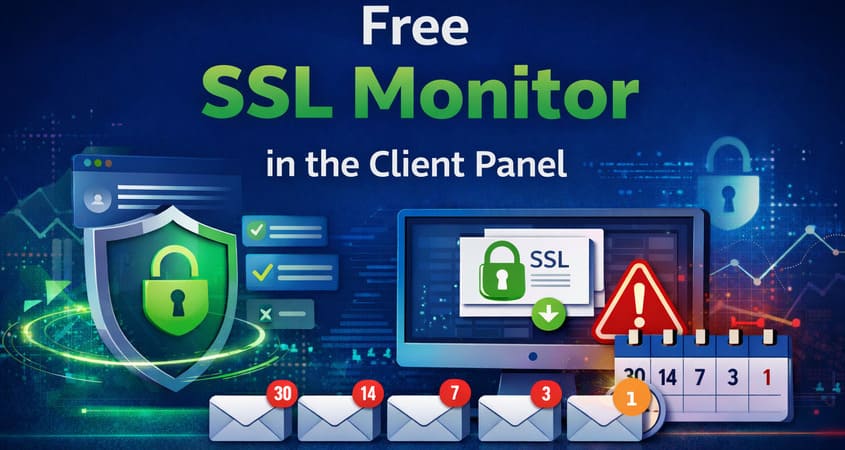
In HEXSSL, we continuously develop our services to support customers not only at the stage of purchasing and deploying SSL/TLS certificates, but also in their ongoing maintenance. That is why we have made a free SSL Monitor service available in the client panel. It allows customers to monitor certificate expiration dates and automatically sends reminders well in advance when action is needed. This solution is especially important today. As of March 15, 2026, the maximum validity of public TLS/SSL certificates has been reduced to 200 days, and the change schedule provides for a further reduction to 100 days from March 15, 2027 and to 47 days from March 15, 2029.
Why is certificate validity monitoring becoming increasingly important?
For years, many organizations operated in a model where certificate renewal was a relatively infrequent event. Shorter validity cycles mean that certificate management is no longer an occasional task, but becomes part of regular operational processes. According to the current CA/Browser Forum requirements, certificates issued from March 15, 2026 cannot exceed 200 days of validity, from March 15, 2027 the limit will be 100 days, and from March 15, 2029 only 47 days.
In practice, this means more frequent renewals, a greater number of control points, and a higher risk of missing a deadline. The industry openly indicates that with shorter validity cycles, manual certificate management becomes less scalable, while automation and monitoring gain critical operational importance.
What is SSL Monitor in HEXSSL?
SSL Monitor is a free service available to our customers in the client panel that enables monitoring of certificates for upcoming expiration dates. The mechanism works in a simple and practical way. The system supervises certificate validity periods and, when the expiration date approaches, automatically sends email notifications. As a result, the customer receives reminders in advance and can plan renewal without acting under time pressure.
How does the notification system work?
If a certificate is approaching expiration, the system automatically generates email messages:
- 30 days before expiration,
- 14 days before expiration,
- 7 days before expiration,
- 3 days before expiration,
- 1 day before expiration,
This notification model helps maintain a safe time margin. The first reminder provides room to calmly plan the necessary actions, while the following reminders help reduce the risk that the issue will get lost among everyday responsibilities.
What changed in March 2026?
The most important change is that public TLS/SSL certificates can no longer be issued with the previous maximum period of 398 days. According to the current CA/Browser Forum schedule, for certificates issued from March 15, 2026 to March 14, 2027, the maximum validity period is 200 days. The next stage will begin on March 15, 2027, when the limit will drop to 100 days, and from March 15, 2029, the maximum validity period will be 47 days.
This change is therefore not a one time correction, but part of a longer trend that leads to an increasingly shorter certificate lifecycle. In such an environment, monitoring stops being an extra and becomes a practical tool supporting the daily maintenance of services.
Why does this matter to customers?
Shorter certificate validity means more frequent renewals. The more often the renewal process must be revisited, the more important operational order, visibility of deadlines, and automatic reminders become. Official industry materials after the changes of March 15, 2026 came into effect explicitly emphasize that more frequent renewals increase the importance of automation, certificate lifecycle management, and active monitoring. In practice, this means several things for the customer. First, it becomes easier to miss a deadline when the renewal cycle is shorter than before. Second, with a larger number of domains, services, or certificates, the scale of the problem increases. Third, certificate expiration can lead to security warnings, service availability issues, and unnecessary reputational risk. These consequences do not result from the rule change itself, but from the way certificates and browsers work. That is why structured deadline monitoring is now becoming a standard of good operational practice.
What benefits does SSL Monitor provide?
Making SSL Monitor available in the client panel is a practical response to real changes taking place in the certificate market.
Better control over the certificate lifecycle.
The customer gains a simple mechanism that reminds them of the approaching end of a certificate’s validity period. This is especially important where many domains, subdomains, or services are used.
Reduced risk of accidental expiration.
Automatic notifications help avoid situations in which a certificate expires without any response from the responsible person or team.
Greater predictability with shorter validity cycles.
In the 200 day model, and ultimately in even shorter models, manually tracking deadlines becomes much more difficult. System reminders organize this process and make it possible to act in advance.
Free access within the client panel.
The service has been made available at no additional cost to our customers using our client panel, making certificate validity monitoring a natural part of day to day service management.
Monitoring is not a luxury, but a response to the direction of change.
The CA/Browser Forum schedule clearly shows the direction of the market: shorter validity periods, shorter reuse periods for validation data for domain names and IP addresses, and a growing need for structured certificate management. For domain and IP validation, the maximum data reuse period has been reduced to 200 days from March 15, 2026, is set to decrease to 100 days from March 15, 2027, and then to 10 days from March 15, 2029.
This further strengthens the importance of monitoring and automation. The shorter the lifecycle of a certificate and related validation processes, the smaller the margin for improvisation.
The free SSL Monitor available in the client panel is a service that helps our customers control certificate validity dates and react well in advance. The system automatically sends email notifications 30, 14, 7, 3, and 1 day before certificate expiration. In the realities of the market after March 15, 2026, when the maximum validity of public TLS/SSL certificates was reduced to 200 days, and the next stages of change provide for a reduction to 100 days in 2027 and 47 days in 2029, such a tool becomes even more necessary.
SSL Monitor is a simple, practical, and free element supporting certificate management at a time when certificate lifecycles are becoming shorter and shorter, and timely action is becoming increasingly important.